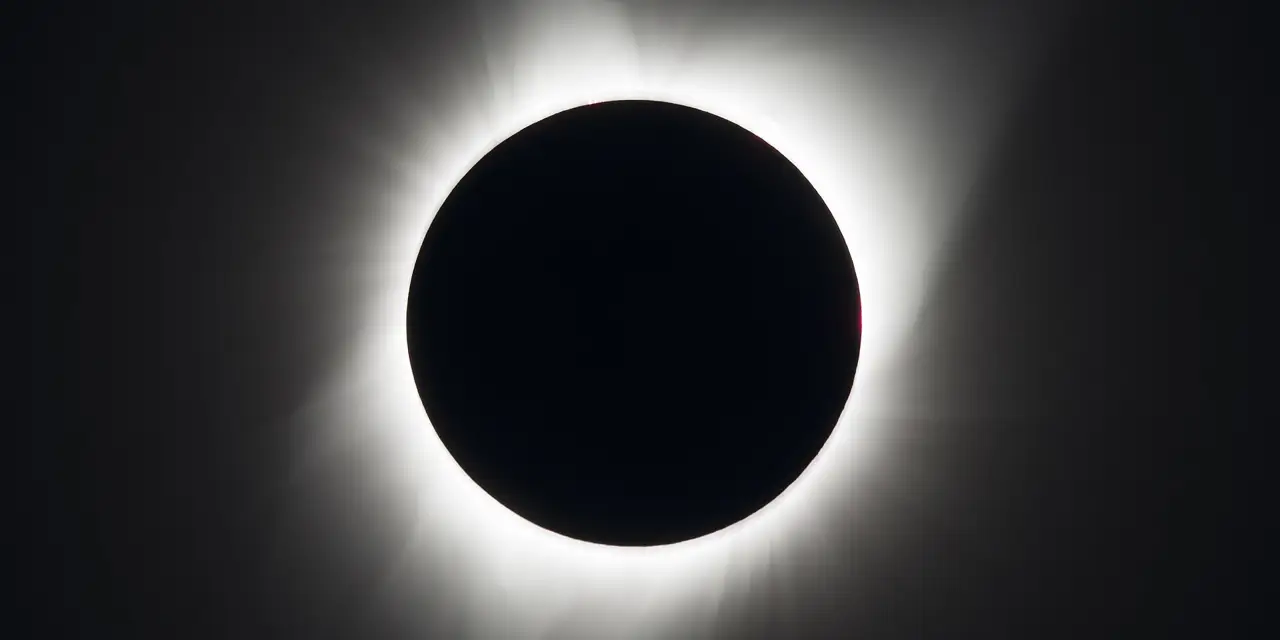
The total solar eclipse of August 2, 2027 will last up to 6 minutes 23 seconds at its longest point, in southern Egypt. It is the second-longest total solar eclipse of the 21st century, and no longer total eclipse happens anywhere on Earth until June 3, 2114. It leads the 2027 sky calendar below, but the United States gets only a sliver of it at sunrise, so most of the year's other events are easier to see from home.
All times are in UTC (Coordinated Universal Time), with Eastern Time added where it helps. Eastern Standard Time (EST) is 5 hours behind UTC, and Eastern Daylight Time (EDT), used from March 14 to November 7, 2027, is 4 hours behind. For the end of this year, see our December 2026 sky guide.
The 2027 sky calendar, month by month
| Month | Event | Date and time (UTC) | From the US? |
|---|---|---|---|
| January | Quadrantid meteor shower peak | Jan 4, shortly after 03:00 (Jan 3, about 10 p.m. EST) | Yes, little moonlight |
| January | Closest full Moon of the year (supermoon) | Jan 22, 12:17 (7:17 a.m. EST) | Yes |
| February | Annular solar eclipse | Feb 6, about 16:00 | No |
| February | Jupiter at opposition | Feb 11, 00:29 (Feb 10, 7:29 p.m. EST) | Yes |
| February | Mars at opposition | Feb 19 | Yes |
| February | Penumbral lunar eclipse | Feb 20, maximum about 23:13 (6:13 p.m. EST) | Yes, but the dimming is subtle |
| March | March equinox | Mar 20, 20:25 (4:25 p.m. EDT) | Everywhere |
| April | Lyrid meteor shower peak | Apr 23, about 01:40 (Apr 22, 9:40 p.m. EDT) | Yes, but bright Moon |
| May | Eta Aquariid meteor shower peak | May 6 | Yes, New Moon |
| June | June solstice | Jun 21, 14:11 (10:11 a.m. EDT) | Everywhere |
| July | Earth at aphelion, its farthest point from the Sun | Jul 5, 05:06 | Not visible |
| August | Total solar eclipse | Aug 2, greatest eclipse about 10:07 (6:07 a.m. EDT) | Partial at sunrise, northern Maine only |
| August | Perseid meteor shower peak | Aug 13 | Yes, but a bright waxing Moon |
| August | Penumbral lunar eclipse | Aug 17, maximum about 07:14 (3:14 a.m. EDT) | Yes, but very faint |
| September | September equinox | Sep 23, 06:02 (2:02 a.m. EDT) | Everywhere |
| October | Saturn at opposition | Oct 18, 00:36 (Oct 17, 8:36 p.m. EDT) | Yes |
| October | Orionid meteor shower peak | Oct 22 | Yes, but moonlit |
| November | Leonid meteor shower peak | Nov 18 | Yes, but moonlit |
| December | Geminid meteor shower peak | Dec 14, about 20:00 (3 p.m. EST) | Yes, but full Moon the night before |
| December | December solstice | Dec 22, 02:42 (Dec 21, 9:42 p.m. EST) | Everywhere |
| December | Ursid meteor shower peak | Dec 23, about 04:00 (Dec 22, 11 p.m. EST) | Yes, good conditions |
The August 2, 2027 total solar eclipse
A total solar eclipse is an event in which the Moon passes directly between the Sun and Earth and covers the Sun's bright face completely. On August 2, 2027, the Moon's dark inner shadow (the umbra) first touches down in the Atlantic at 08:23 UTC and lifts off over the Indian Ocean at 11:49 UTC, 3 hours 26 minutes later.
The path of totality is about 250 km (150 miles) wide. It crosses the Atlantic, then southern Spain, Gibraltar and northern Morocco, then Algeria, Tunisia, Libya and Egypt. It clips a corner of Sudan, crosses the Red Sea into Saudi Arabia and Yemen, and ends at the tip of Somalia. Cities in the path include Cádiz and Málaga in Spain, Tangier in Morocco, Benghazi in Libya, Luxor in Egypt, and Jeddah and Mecca in Saudi Arabia.
NASA lists the longest totality at 6 minutes 23.2 seconds. The point of greatest eclipse lies in southern Egypt, about 50 km (30 miles) east of Luxor, where totality begins just after 1 p.m. local time. Luxor itself gets 6 minutes 22 seconds.
| Place | Totality | Totality begins (UTC) |
|---|---|---|
| Tangier, Morocco | 4 min 51 s | about 08:44 |
| Tarifa, Spain | 4 min 40 s | about 08:45 |
| Gibraltar | 4 min 28 s | about 08:45 |
| Málaga, Spain | 1 min 57 s | about 08:48 |
| Sfax, Tunisia | 5 min 41 s | about 09:08 |
| Benghazi, Libya | 6 min 11 s | about 09:27 |
| Luxor, Egypt | 6 min 22 s | about 10:02 |
| Jeddah, Saudi Arabia | 5 min 55 s | about 10:22 |
Why is this eclipse so long?
Three things line up. The Moon passes perigee, its closest point to Earth, only a few hours before the eclipse, so it looks larger than the Sun and covers it with room to spare. Earth is four weeks past aphelion (July 5, 2027), so the Sun looks slightly smaller than average.
The third factor is geography. Over southern Egypt the shadow arrives close to local noon, in the tropics, where Earth's surface moves fast in the same direction as the Moon's shadow, so the shadow crosses the ground more slowly. Astronomers put the theoretical maximum for any total eclipse at about 7.5 minutes, so 6 minutes 23 seconds is not far off.
Is it the longest eclipse of the century?
Not quite. The July 22, 2009 eclipse lasted about 15 seconds longer, but its longest point was over the Pacific Ocean. NASA's eclipse catalogs show no total eclipse anywhere on Earth longer than the 2027 one until June 3, 2114, when totality will reach 6 minutes 32 seconds.
Can you see it from the United States?
No total eclipse is visible from the US. NASA says only a partial eclipse reaches the country, in northern Maine, where it lasts only from about 5:14 to 5:19 a.m. EDT, around sunrise. Most of Europe, much of Africa and the Middle East see a partial eclipse, and so do eastern Canada and parts of Asia.
Weather favors Egypt, where August satellite records suggest cloud-free skies along the path, with average cloud cover of 0 percent at Luxor, Asyut and Minya. Averages are 9 to 17 percent around Málaga, Tarifa and Gibraltar and 42 percent at Tangier. Dust storms from the Sahara are an occasional risk across North Africa.
Eye safety
NASA says solar viewers and eclipse glasses should meet the ISO 12312-2 international standard. Keep them on for the whole partial phase. You may take them off only during totality, when no part of the Sun's bright face can be seen through them, and must put them back on as soon as the Sun starts to reappear.
Regular sunglasses are not safe, however dark they are. Never look at the Sun through a camera, binoculars or a telescope unless it has its own proper solar filter on the front; eclipse glasses are not enough for those. Throw away viewers that are scratched or torn, and supervise children.
The other 2027 eclipses
An annular solar eclipse happens when the Moon is too far away to cover the Sun completely, leaving a bright ring. The one on February 6, 2027 peaks at about 16:00 UTC. NASA says the ring can be seen from parts of Chile, Argentina, Uruguay and Brazil, then Ivory Coast, Ghana, Togo, Benin and Nigeria, and lists a maximum ring time of 7 minutes 51 seconds. It is not visible from the United States.
There is no total lunar eclipse in 2027. Two penumbral lunar eclipses are visible from North America. A penumbral eclipse is one in which the Moon passes through only the faint outer part of Earth's shadow, so the dimming is slight. The first peaks on February 20 at about 23:13 UTC (6:13 p.m. EST). The second, fainter one peaks on August 17 at about 07:14 UTC (3:14 a.m. EDT).
Meteor showers and the Moon in 2027
The International Meteor Organization (IMO) publishes peak times and notes the moonlight for each shower, and 2027 is mixed. The Quadrantids peak on January 4 shortly after 03:00 UTC, which is the evening of January 3 in the US, shortly before New Moon on January 7. The IMO lists rates of 80 or more meteors an hour under ideal dark skies.
The Perseids peak on August 13, with 110 or more an hour in ideal conditions. The Moon sits midway between first quarter (August 9) and full (August 17), so the moonless part of the night is short.
The Geminids peak on December 14, centered near 20:00 UTC, with up to 150 an hour in ideal conditions. The full Moon on December 13 washes out most of them. The Lyrids (peak April 23) come three days after a full Moon, the worst conditions of the big showers, and the Orionids (October 22) and Leonids (November 18) also fight moonlight. The Eta Aquariids (May 6) and the Ursids (December 23) have good conditions.
Supermoons and planets
A supermoon is a full Moon that happens near perigee, when the Moon is closest to Earth. The full Moon of January 22 (12:17 UTC) is the closest of 2027, at about 357,600 km (222,200 miles).
Jupiter reaches opposition on February 11 (the evening of February 10 in the US) and Mars on February 19. Opposition is when a planet sits opposite the Sun in our sky, so it rises around sunset and stays up all night. Mars passes closest to Earth on February 20, about 63 million miles (101 million km) away, and looks slightly smaller in a telescope than it did in 2025. Saturn reaches opposition on October 18 (the evening of October 17 in the US).
The year's equinox and solstice moments are March 20 at 20:25 UTC, June 21 at 14:11 UTC, September 23 at 06:02 UTC and December 22 at 02:42 UTC.