The word “sail” suggests wind, but the force comes from light. The engineering challenge is to make a broad reflective surface and its supports light enough for sunlight’s gentle push to move a spacecraft.
That push can be adjusted by changing the sail’s angle. Solar sails have been tested in space, while other designs have been proposed for scientific missions.
A typical solar-sail spacecraft has a reflective membrane supported by structural beams called booms.
NASA’s Solar Cruiser sail design used a thin-film polymer membrane. The membrane was coated with aluminium to make it reflective.
How Does a Solar Sail Move and Steer?
A solar sail moves because photons—the particles of light—carry momentum that can be transferred when they strike the sail. Reflecting sunlight transfers momentum to the membrane and produces thrust, a force that moves the spacecraft.
The sail can change the direction and size of the force by changing its angle to incoming sunlight. This lets the spacecraft steer by adjusting its orientation. The thrust is continuous, and the spacecraft does not need to carry conventional rocket propellant for that thrust.
What Makes Solar Sails Remarkable?
NASA’s Advanced Composite Solar Sail System, or ACS3, has a sail measuring about 80 square metres when unfurled. Before deployment, the spacecraft is about the size of a microwave.
Four diagonal booms, each about 7 metres long, support the sail. Two of the booms could be rolled up to fit in the palm of a hand. The composite booms are 75% lighter than previous boom designs, helping the spacecraft carry a large sail in a compact form.
Where Have Solar Sails Been Used?
Japan’s IKAROS spacecraft launched on 21 May 2010 and demonstrated solar-sail propulsion during interplanetary flight. After the sail deployed, JAXA estimated that sunlight exerted 1.12 millinewtons of thrust on it.
The Planetary Society’s LightSail 2 used a 32-square-metre sail to demonstrate orbit-raising manoeuvres. Its apogee—the highest point in its orbit—increased by about 10 kilometres.
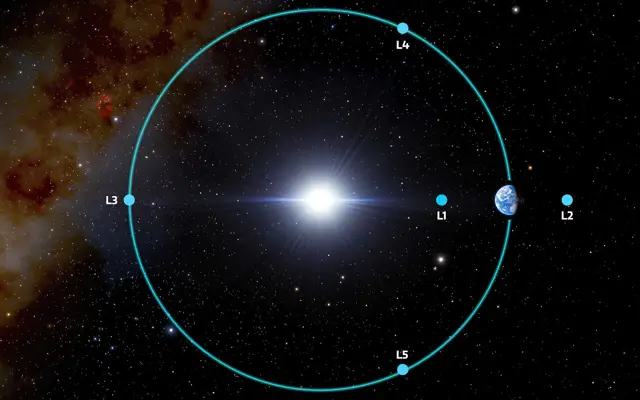
NASA proposed Solar Cruiser to test whether a solar sail could keep a spacecraft sunward of the Earth–Sun L1 point for solar and space-weather observations. The mission was not approved to proceed to Phase C.
What Are Solar Sails’ Limits—and What Don’t They Catch?
Solar sails are pushed by sunlight, not by the solar wind, which is a stream of charged particles. The two are different: sunlight transfers momentum through photons, while the solar wind consists of particles.
At Earth’s distance from the Sun, an ideal, perfectly reflective solar sail experiences about 9.1 micronewtons of light pressure per square metre. That pressure decreases with the square of the sail’s distance from the Sun, so it becomes weaker farther away.
Because sunlight’s pressure is small, a sail needs a large area to generate useful thrust. This is why solar-sail designs pair a broad membrane with lightweight support structures.