Skip to content

What Are Lagrange Points? Five Cosmic Balancing Acts

A Lagrange point is a position in a rotating system of two large bodies where a much smaller object can keep a nearly constant position relative to them. In the idealised model, only L4 and L5 are stable when the mass ratio is sufficiently large.

Diagram of the five Lagrange points around the Sun and Earth.
Image: NOIRLab/NSF/AURA/J. da Silva Acknowledgment: M. Zamani (NSF’s NOIRLab) / Wikimedia Commons, CC BY 4.0

How Do Gravity and Orbital Motion Create Them?

At each Lagrange point, the combined gravitational effects and the smaller object’s orbital motion balance in a frame rotating with the two larger bodies.

At Sun–Earth L1, Earth’s gravity partly counters the Sun’s pull on a spacecraft between the two bodies. At L2, Earth’s gravity adds to the Sun’s pull, allowing a spacecraft farther from the Sun to keep pace with Earth.

What Makes the Five Points Different?

In the Sun–Earth system, L1, L2 and L3 lie along the line through the Sun and Earth. L4 and L5 sit 60 degrees ahead of and behind Earth in its orbit.

The points differ in stability.

In 2011, NASA reported that its WISE mission had confirmed 2010 TK7, the first known Trojan asteroid associated with Earth’s L4 point.

How Do Spacecraft Use Lagrange Points?

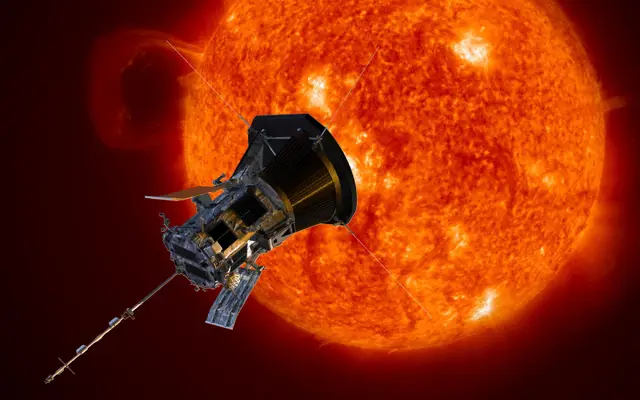
The Sun–Earth L1 point is about 1.5 million kilometres from Earth, towards the Sun. The SOHO spacecraft orbits around L1, where it has an uninterrupted view of the Sun.

The James Webb Space Telescope orbits around Sun–Earth L2, also about 1.5 million kilometres from Earth. From there, its sunshield blocks the Sun, Earth and Moon.

Do Spacecraft Sit Still at a Lagrange Point?

Spacecraft at Sun–Earth L1 and L2 usually travel in halo or Lissajous orbits around the points rather than remaining motionless on them.

L1, L2 and L3 are unstable, so a spacecraft near one of them needs occasional thruster corrections to remain nearby. NASA describes L1 and L2 as unstable on a timescale of about 23 days.


Key facts

Number of points
Five, labelled L1 through L5, in a system of two large bodies.
Stable points
L4 and L5 are stable in the idealised model when the mass ratio is sufficiently large.
Sun–Earth L1 distance
About 1.5 million kilometres from Earth, towards the Sun.
Earth’s first known Trojan asteroid
2010 TK7, associated with L4 and confirmed by NASA in 2011.

Questions people ask

Why are there five Lagrange points?

In a rotating system of two large bodies, the combined gravitational effects and a smaller object’s orbital motion balance at five positions, labelled L1 through L5.

Which Lagrange points are stable?

In the idealised model, L4 and L5 are stable when the mass ratio of the two large bodies is sufficiently large. L1, L2 and L3 are unstable.

Do spacecraft stay motionless at Lagrange points?

No. Spacecraft at Sun–Earth L1 and L2 usually follow halo or Lissajous orbits around the points, and need occasional thruster corrections to remain nearby.

How do spacecraft use the Sun–Earth Lagrange points?

SOHO orbits around L1 for an uninterrupted view of the Sun. The James Webb Space Telescope orbits around L2, where its sunshield blocks the Sun, Earth and Moon.

Sources

  1. Chapter 5: Planetary Orbits — NASA Science · science.nasa.gov
  2. What Is a Lagrange Point? — NASA Science · science.nasa.gov
  3. What are Lagrange points? — European Space Agency · esa.int
  4. SOHO’s Orbit — NASA/ESA SOHO · soho.nascom.nasa.gov
  5. Webb FAQs — NASA Science · science.nasa.gov
  6. Types of orbits — European Space Agency · esa.int

More in Science & Tech

All 35 articles