Advent 2026 begins on Sunday, November 29, 2026, and ends on Christmas Eve, December 24. Advent is the season of preparation before Christmas in Western Christianity, and its name comes from the Latin adventus, meaning "coming" or "arrival." Many people who do not attend church still know it through its two best-known objects: the Advent wreath and the Advent calendar.
This year the four Sundays of Advent fall on November 29 and December 6, 13 and 20.
Advent 2026 dates
The first Sunday of Advent in 2026 is November 29, and the season lasts 26 days from then through December 24. Advent always includes four Sundays, so one more candle is lit on each.
| Sunday | Date in 2026 | Candles lit on a four-candle wreath |
|---|---|---|
| First Sunday of Advent | November 29 | 1 |
| Second Sunday of Advent | December 6 | 2 |
| Third Sunday of Advent | December 13 | 3 |
| Fourth Sunday of Advent | December 20 | 4 |
Christmas Day falls on a Friday in 2026, so Christmas Eve is a Thursday and the fourth Sunday of Advent comes four days before it.
What does Advent mean?
Advent means "arrival," from the Latin adventus, a word that translates the Greek parousia used in the New Testament. That Greek word originally referred to the Second Coming of Christ. The season also looks back to the birth of Jesus, so it points both to Christmas and to the future.
In Western churches, Advent is also the start of the church year. Eastern Orthodox churches follow a different season, the Nativity Fast, which differs from Advent in meaning, length and customs.
How is the start date of Advent worked out?
Advent starts on the fourth Sunday before Christmas Day, which is the Sunday on or closest to November 30. That makes the first Sunday of Advent always fall between November 27 and December 3. Anglican, Lutheran, Moravian, Presbyterian and Methodist churches use this rule.
Christmas is fixed on December 25 but the weekday changes each year, so the season is not always the same length. It runs from 22 to 28 days. In 2026 it is 26 days, from Sunday, November 29 to Thursday, December 24.
A few churches count differently. The Ambrosian and Mozarabic rites start Advent six Sundays before Christmas, on the Sunday on or closest to November 16. In 2026 that is November 15.
Who invented the Advent wreath?
The modern Advent wreath was created in 1839 by Johann Hinrich Wichern (1808-1881), a Lutheran pastor in Hamburg, Germany. Wichern ran the Rauhes Haus, a home for needy children, and the children there kept asking whether Christmas had arrived.
His answer was a wooden ring about the size of a wagon wheel, set up in the home's prayer room. It carried red and white candles. A red candle stood for each ordinary day and a white one for each Sunday of Advent, and the number of red candles ranged from 18 to 24, depending on the date of the first Sunday. A candle was lit each day until all were burning on Christmas Eve.
Fir branches were added from 1860. The small four-candle wreath used in homes today is a reduced version, made so that families could have one in their own living rooms.
The custom spread slowly. German Protestant churches took it up first, Catholics in Germany began using it in the 1920s, and it did not reach the United States until the 1930s.
What do the Advent candle colors mean?
The Advent candle colors depend on the church, and there is no single standard. In Roman Catholic churches and many Protestant ones, the wreath holds three violet candles and one rose-colored candle. The rose candle is lit on the third Sunday, known as Gaudete Sunday, from the Latin for "rejoice." In 2026 that is December 13.
Violet is the usual color of the season in Western churches, and some Protestant churches use blue instead. Many Protestant churches in the United Kingdom use four red candles.
The meanings vary too. A common set for the four candles is hope, peace, joy and love. Some traditions name them instead for the Messiah or prophecy, Bethlehem, the shepherds and the angel, and some UK churches link their four red candles to God's people, the Old Testament prophets, John the Baptist and Mary.
Some wreaths add a fifth, white candle in the center, called the Christ candle. It is lit on Christmas Eve or Christmas Day.
Where does the Advent calendar come from?
The Advent calendar began in German Lutheran homes in the 1800s, as a way to count the days to Christmas. Early methods were simple, such as drawing a chalk line on a door each day. A handmade wooden calendar from about 1851 is among the earliest known.
The printed calendar is credited to Gerhard Lang (1881-1974), a Munich publisher whose father was a Lutheran priest. Lang's Weihnachts-Kalender ("Christmas calendar"), also known as Im Lande des Christkinds ("In the Land of the Christ Child"), appeared in the early 1900s. It had 24 windows holding Christmas verses, and a sheet of small pictures could be cut out and pasted over them. A fully pasted-over copy is pictured at the top of this page.
After the Second World War, a Stuttgart publisher named Richard Sellmer began printing Advent calendars in 1945, and American soldiers bought some and sent them home. Demand in the United States jumped after 1953, when a widely published photo showed President Eisenhower's family with an Advent calendar.
Cadbury launched the first chocolate Advent calendar in the UK in 1971. Calendars with little or no religious content, such as ones filled with toys or beauty products, took off in the 1990s.
Advent customs around the world
Germany
Germany is where both the wreath and the printed calendar began, and the first Sunday of Advent marks the start of the Christmas season there. The Advent wreath is still the best-known symbol of the season.
Sweden
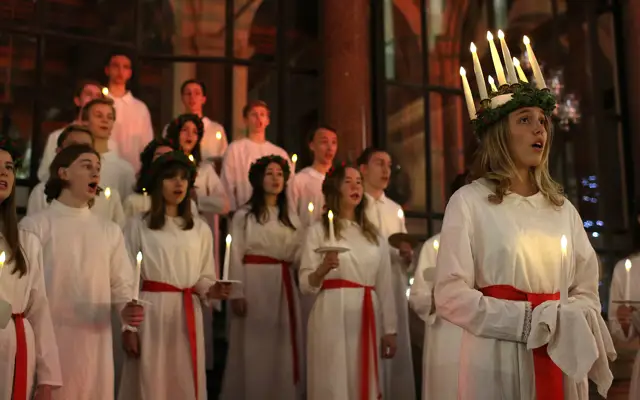
In Sweden, Christmas celebrations usually start with the first Sunday of Advent at the end of November, and many Swedes go to church that day. The third and fourth Sundays are busy ones for families, with baking and cooking. The Feast of St. Lucy on December 13, which is also the third Sunday of Advent in 2026, is marked with processions in schools, preschools and companies. A Christmas calendar also begins on Swedish television and radio on December 1.
The giant straw Gävle Goat is also unveiled on the first Sunday of Advent. For that story, see strange Christmas traditions around the world.
The Philippines
Simbang Gabi is a series of nine Masses held on the nine days from December 16 to 24 in the Philippines, usually starting around 4 a.m. Some parishes hold evening versions on December 15 to 23. The last one, on Christmas Eve, is called Misa de Gallo. Rice treats such as bibingka and puto bumbong, a steamed purple rice pastry, are traditional with the Masses, and a popular belief holds that a request made during the nine days may be granted if all nine are attended.
For the wider Christmas story, see where 12 Christmas traditions really come from.