Christmas traditions come from several places at once: church calendars, German home customs, Dutch saint's-day habits and the inventors and printers of the 1800s. Most of them can be traced to a dated record, while a few famous origin stories, such as the candy cane legend, have nothing behind them.
1. Why is Christmas on December 25?
December 25 is not a date from the Bible: the Gospels give no day or season for Jesus's birth. The earliest surviving record of that date is a Roman calendar of 354 CE, compiled by Furius Dionysius Filocalus, which lists "Natus Christus in Betleem Iudeae" (Christ born in Bethlehem of Judea).
One explanation says Christians chose the date to match a Roman festival. Emperor Aurelian set up the "Birthday of the Unconquered Sun" (Sol Invictus) on December 25 in 274 CE. Saturnalia is a weaker fit: even in its longest form it ended on December 23. The earliest hint that Christians picked the date to match a pagan feast is a note written in the margin of a 12th-century manuscript by the Syriac commentator Dionysius bar-Salibi.
The other explanation is a calculation. Around 200 CE the North African writer Tertullian linked the crucifixion to March 25, and some early Christians held that a holy person was conceived and died on the same date. Nine months after March 25 is December 25. Historians say the origin cannot be known for certain, and some argue the two explanations are not rivals.
2. Why do we put up a Christmas tree?
The earliest written description of a Christmas tree comes from Strasbourg in 1605, where a home tree was decorated with candles, apples, communion wafers, paper roses and foil shapes. The custom was already German by then, and it reached Britain in the 1700s: Newcastle University's special collections credits Queen Charlotte with introducing it.
It became a mass fashion through a picture. In December 1848 The Illustrated London News printed an engraving of Queen Victoria, Prince Albert and their family around a decorated tree at Windsor Castle. The Victoria and Albert Museum says the paper's wide circulation helped popularize the German tradition in Britain, and the first advertisements for tree ornaments appeared in 1853.
The popular story that Martin Luther added the first candles to a tree is a legend: there is no contemporary record of it.
3. Why do we hang Christmas stockings?
The usual answer is a legend about Saint Nicholas, an early Christian saint from what is now Turkey. In the story, a poor man cannot afford dowries for his three daughters, and Nicholas drops gold down the chimney or through a window, where it lands in stockings drying by the fire.
The story is folklore, not a documented event. What is documented is that in some countries children leave shoes, not stockings, to be filled, and that Clement Clarke Moore's poem "A Visit from St. Nicholas," first printed in 1823, describes stockings "hung by the chimney with care." The orange or tangerine in the toe of many stockings is said to stand for the saint's gold.
4. Why do we kiss under mistletoe?
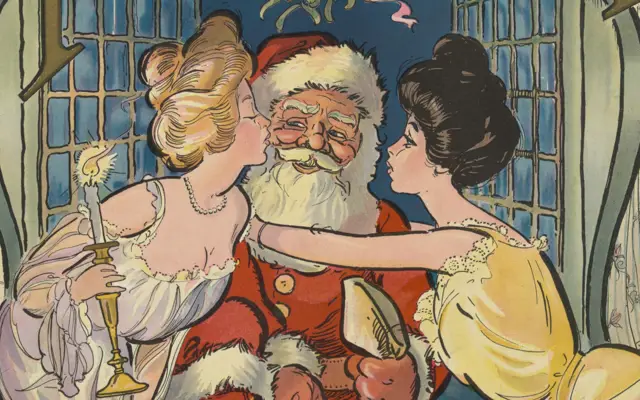
Mistletoe is a plant that grows on trees and stays green in winter, and that is why it has been given meanings for centuries. Popular accounts link the kiss to the Druids of the 1st century CE, who treated it as a sign of life, and to a Norse myth in which the god Baldur is killed with a mistletoe arrow and his mother Frigg declares the plant a symbol of love.
The kissing custom itself is documented later. By the 18th century mistletoe was part of English Christmas celebrations, and the kissing tradition appears to have started among English servants before spreading to the middle classes. In the early custom a man could claim a kiss from a woman standing under it, and some people removed one berry per kiss until none were left. How a sacred herb became a Christmas decoration remains unsettled.
5. Why do we have candy canes?
The popular story says that a 17th-century choirmaster at Cologne Cathedral (often dated to 1670) gave sugar sticks bent like shepherds' crooks to children to keep them quiet during a nativity service. National Geographic calls that story unsubstantiated, so it is best treated as a legend.
The idea that the cane is a "J" for Jesus is an urban legend, according to a food historian quoted by History.com. The earliest documented American appearance is generally credited to August Imgard, a German immigrant in Wooster, Ohio, who decorated a tree with candy canes in 1847, and those canes were probably all white. The origin of the red stripes is unclear, though an 1844 cookbook already gives instructions for striped peppermint sticks.
Mass production came later. Gregory Keller, a Catholic priest and the brother-in-law of Bob McCormack, is credited with a machine that bent the canes automatically, and McCormack's candy company in Albany, Georgia, grew into a major maker.
6. Why do we send Christmas cards?
The first commercial Christmas card was commissioned in 1843 by Sir Henry Cole, who later became the first director of the Victoria and Albert Museum. He asked the artist John Callcott Horsley to design it, and Cole's diary entry of 17 December 1843 records receiving the design.
Cole had 1,000 copies printed and sold them for one shilling each, which was expensive at the time. The museum describes the venture as a commercial flop. Cards only became a mass habit later in the 19th century, when better color printing (chromolithography) made them affordable.
7. Why does Santa Claus bring presents?
Santa Claus grew out of Saint Nicholas, a saint born in what is now Turkey whose feast day is December 6. Dutch immigrants in New York celebrated that day as "Sinter Klaas," and the writer Washington Irving included the character in his 1809 satire A History of New York.
The Santa of Moore's 1823 poem, first published anonymously in the Troy Sentinel on December 23, 1823, wears fur, smokes a pipe and is never called "Santa" or described in a red coat. The Library of Congress says Santa's red coat, pipe, workshop and North Pole home first appeared in the drawings of cartoonist Thomas Nast, whose Santas ran in Harper's Weekly from 1863 into the 1880s, including "Merry Old Santa Claus" on January 1, 1881.
8. Why do we light an Advent wreath?
The Advent wreath was invented in Hamburg, Germany. Johann Hinrich Wichern, founder of the Rauhes Haus children's home, lit the first one in 1839 in the home's prayer room, according to Hamburg's tourist board.
That wreath was a wooden ring about the size of a wagon wheel, with red candles for ordinary days and white ones for the Sundays of Advent. Fir branches were added from 1860, and the small four-candle version used in living rooms is a reduced form of the original.
9. Why do we decorate with Christmas lights?
Before electricity, trees were lit with wax candles, and newspapers regularly reported tree fires. The first electric tree is credited to Edward Johnson, who put 80 hand-wired red, white and blue bulbs on a tree in the parlor of his New York home at Christmas 1882.
A reporter from the Detroit Post and Tribune described "a continuous twinkling of dancing colors," and the tree turned slowly on a pedestal. Lights stayed a rich person's novelty for years: in 1903 General Electric began selling eight-lamp strings, and a three-string set cost $12, while some department stores rented them for $1.50.
10. Why do we use Advent calendars?
Advent calendars began in 19th-century German Lutheran homes as a way to count down to Christmas. Families drew chalk lines on doors, and by the late 1800s handmade calendars appeared, with one of the earliest known wooden examples dating from about 1851.
Gerhard Lang (1881-1974), a Munich publisher, is credited with the first modern commercially printed Advent calendar, "Im Lande des Christkinds" ("In the Land of the Christ Child"), in the early 1900s. Around 1920 Lang added small doors for each day, and other publishers soon copied the format.
11. Why do we pull Christmas crackers?
London confectioner Tom Smith is credited with inventing the Christmas cracker in 1847, after a trip to Paris where he saw bonbons (sugared almonds wrapped in twisted paper). By 1849 toys and trinkets had replaced the sweet inside a larger wrapper, and the V&A says he perfected the "bang" in the 1860s.
Smith was not the only maker: Gaudente Sparagnapane, an Italian-born London confectioner, founded his company in 1846 and claimed to be the oldest cracker maker. Cracker historian Peter Kimpton suggests Smith may simply have been an excellent marketer who convinced people the idea was his. The early mottoes were romantic and were gradually replaced by jokes.
12. Why do we build gingerbread houses?
The popular answer is Hansel and Gretel, but the Brothers Grimm did not write about a gingerbread house. Their 1812 tale describes a house "built of bread and covered with cakes."
After the story was published in 1812, building gingerbread houses became a popular pastime in Germany. Food historians still debate whether the Grimms drew on existing gingerbread houses or inspired people to make them. Molded and painted gingerbread itself was well established in Germany by the 15th and 16th centuries.