A comet’s coma is the cloud of gas and dust surrounding it.
What Was Found?
The methane in 3I/ATLAS has a deuterium-to-hydrogen (D/H) ratio of 3.18 ± 0.30%. The ratio compares the amount of heavy hydrogen, called deuterium, with ordinary hydrogen in the methane.
The measured ratio is about 13 ± 2 times the value found in comet 67P/Churyumov–Gerasimenko. It also exceeds every other methane D/H value measured in the Solar System.
How Was the Methane Ratio Measured?
The 3I/ATLAS measurement used near-infrared spectra of the comet’s gas-and-dust coma, collected by the James Webb Space Telescope. Its NIRSpec instrument observed the comet on 22 and 23 December 2025.
The analysis covered wavelengths around 3.25–3.33 micrometres, where the researchers examined signals from methane and deuterated methane. They modelled and removed contributions from other molecular emissions, including methanol, formaldehyde and excited hydroxyl, to isolate the methane signals and estimate the isotope ratio.
What Are Deuterium and a D/H Ratio?
Deuterium is a form of hydrogen whose atom has one proton and one neutron; ordinary hydrogen has one proton and no neutron. In deuterated methane, one of methane’s hydrogen atoms is replaced by deuterium.
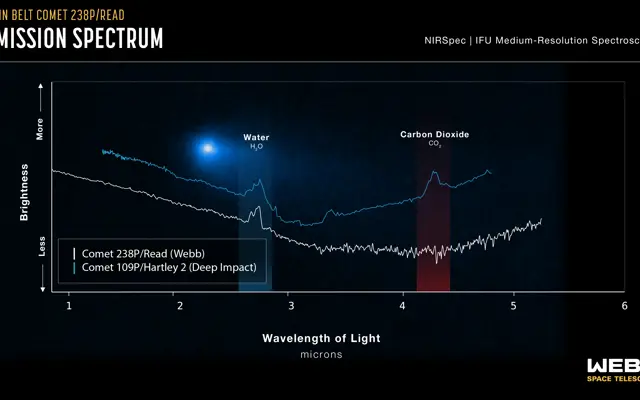
Spectroscopy separates light into its component wavelengths. Molecules leave characteristic patterns in a spectrum, which can reveal the chemical composition of the object being observed. Here, comparing the methane and deuterated-methane signals gave the team a way to estimate how much deuterium the comet’s methane contains relative to ordinary hydrogen.
What Does the Ratio Suggest About 3I/ATLAS’s Birthplace?
The high methane D/H ratio in 3I/ATLAS is consistent with its ices forming in a very cold, low-metallicity interstellar or protostellar environment. Low metallicity means an environment with relatively little material heavier than hydrogen and helium.
The proposed setting also involves a high rate of cosmic-ray irradiation. This is an interpretation of the measurement, not a direct identification of the comet’s birthplace. Both 3I/ATLAS and 67P have more deuteration in methane than in water. In other Solar System bodies and the nearby interstellar medium, deuteration in organic molecules can exceed that in water by up to about an order of magnitude.
What Is Still Unknown?
The 3I/ATLAS result is the first observational measurement of methane’s D/H ratio in an extrasolar source. Before it, 67P/Churyumov–Gerasimenko was the only other comet in which deuterated methane had been detected.
The comet comparison sample is very small. The ratio is consistent with either an interstellar or a protostellar formation environment, and the measurement alone does not settle which setting gave rise to the methane.