Bluetooth is a wireless technology with several ways to organise radio communication. Bluetooth Classic and Bluetooth Low Energy use different channel arrangements, while Bluetooth Mesh adds its own way to address parts of devices.
1. Bluetooth Was Named After a Viking King
The name Bluetooth was suggested as a temporary code name in 1996, and it was not intended to be an acronym. It refers to Harald Bluetooth Gormsson, a king who united Denmark and Norway in 958.
The Bluetooth logo also carries a reference to Harald. It combines two Younger Futhark runes that represent his initials.
2. Bluetooth Classic Can Hop 1,600 Times a Second
Bluetooth Classic can change radio channels up to 1,600 times per second while connected. It uses 79 radio-frequency channels, spaced 1 megahertz apart.
The connection runs in radio slots that are 625 microseconds long. At the maximum hop rate, Bluetooth Classic changes channels once per 625-microsecond radio slot, rather than staying on one frequency.
3. Bluetooth Can Skip Radio Channels That Are Busy
Bluetooth can classify radio channels as used or unused, then leave unused channels out of its hopping sequence. This feature is called adaptive frequency hopping.
The system can use fewer than all 79 channels, but it must keep at least 20 in the sequence. Adaptive frequency hopping is designed to improve resistance to interference in the 2.4 gigahertz band.
4. Bluetooth Low Energy Has 40 Radio Channels
Bluetooth Low Energy uses 40 radio-frequency channels in the 2.4 gigahertz band. Each channel is spaced 2 megahertz apart.
The channels have two different roles: three are for advertising, and the other 37 are for general-purpose use. This channel plan differs from Bluetooth Classic’s 79 channels, reflecting that the two Bluetooth systems organise radio communication differently.
5. Bluetooth Can Broadcast Without Connecting
Bluetooth Low Energy advertising can send information without establishing a connection between the sender and receivers. The advertising device sends application data one way to scanning devices within range.
A Bluetooth Low Energy advertising device can broadcast to an unlimited number of scanning devices in range. That makes advertising a different kind of communication from a direct connection: receivers can scan for the broadcast without each one forming a separate connection to its sender.
6. Bluetooth Range Can Exceed a Kilometre
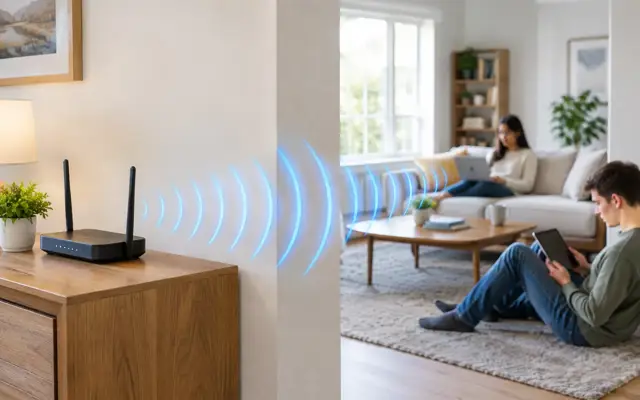
Bluetooth’s effective, reliable range can be more than 1 kilometre in some designs, but it can also be less than 1 metre. There is no single fixed distance that applies to every Bluetooth link.
Range depends on several factors, including radio power, antenna design, the radio’s physical layer and obstacles between devices. The physical layer is the part of the system that handles how radio signals are sent and received.
7. Bluetooth Mesh Can Address 32,767 Elements
A Bluetooth Mesh network can contain up to 32,767 addressable elements. An element is an addressable part of a device, and one device can contain multiple elements.
Mesh messages can travel a maximum of 127 hops. A hop is a step as a message moves through the network, so the limit describes how far a message can be relayed through Bluetooth Mesh—not how many devices the network can contain.